Interviews
Interview with Jeanne de Pellegars, WILLA
Jeanne de Pellegars shares the key stages in supporting entrepreneurs and the challenges in launching, accelerating, and growing a business.
A story shaped by opportunities and bold choices: bootstrapping, scale-up, external growth, fundraising… and a clear vision for the future. Each stage a step closer to becoming the leader in its field.
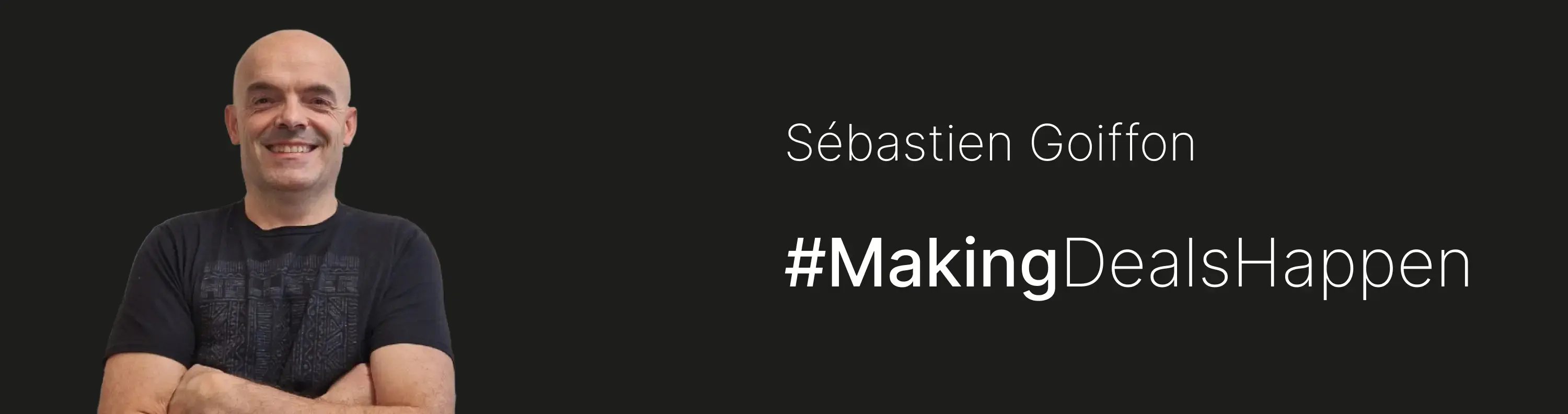
DEALCOCKPIT : What inspired you to set up Wiiisdom?
Sébastien Goiffon : At the time, I was a consultant, and I had a client facing a problem that I thought I could solve. So I developed a solution and quickly realised that it met a much broader, if not global, need.
And so, full of enthusiasm, I set out on my entrepreneurial journey. You need a touch of madness to take the plunge, because if you start planning everything and weighing up every risk, you’ll never get started. I saw the opportunity straight away and seized it.
Originally, before the rebranding in 2021, the company was called GB&Smith. We started in France, then expanded first to the UK, then to the US and Canada. At the time, 25% of our turnover came from the US; today, it’s 60%.
DC : How would you explain BI & Analytics Governance in simple terms to a novice?
Sébastien G. : Business Intelligence (BI) is a branch of IT pioneered by the French company Business Objects. This suite of software and techniques enables data to be analysed in order to make informed strategic decisions.
For example, before starting my own business, I worked at Orange. There, we analysed past sales to anticipate peaks in activity and adjust stock levels accordingly.
Nowadays, we often hear that data is the oil of the 21st century. That’s true, but you need to be able to analyse and manage it properly. At Wiiisdom, our role is precisely to establish robust governance around these tools, to ensure that decisions are based on reliable, high-quality information.
DC : Your first customers were from the US and the UK. Was that a deliberate strategic choice from the outset, or an opportunity that arose?
Sébastien G. : I’d say both. At the time, there were two of us in the firm, one based in Lille and the other in Bordeaux… and our first two clients were overseas: an insurance company in England and the Department of Environmental Protection in the United States.
There’s a significant difference between the French and American markets that surprised me at first. Now that I live in the US, I understand how they operate, which is very straightforward: problem – solution. “How much is this problem costing me? How much will I save compared to the cost of the solution?” If the figures add up, they buy. They are constantly focused on innovation and have a very direct approach to spending.
In France, however, people were more interested in which school I’d attended and what references we had as a company.
So, initially, we had a very strong customer base abroad. Once the French market had matured and we had solid references, we returned to develop our business in France.
DC : Your company has been a real success story: a French entrepreneur, a headquarters in Lille, exporting its business all over the world – did you ever imagine this when you first started out?
Sébastien G. : I’m not sure if you can call it a ‘success story’ in the Nasdaq sense. We bootstrapped for 15 years, which may seem commonplace today, but back then was by no means the norm. We were profitable from day one, whereas the prevailing narrative was all about massive fundraising rounds and explosive growth. We managed to grow in a fairly steady, linear fashion.
In fact, today we have 85 employees and serve the world’s largest companies and government bodies: banks, pharmaceutical companies, and regulators such as the Fed or the FDA. It’s always funny to think that a small company from Lille is able to make an impact on the world’s biggest organisations.
DC : After 15 years of bootstrapping, you’ve made several strategic shifts. The first came in 2021, and rather surprisingly, it involved external growth. Why this particular choice?
Sébastien G. : Historically, we had been using Business Objects technology, and at the time we were in discussions with US Bank, one of the largest US banks. They were using two technologies—Business Objects and Tableau—and needed a governance solution that covered both.
We had two options: develop a new technology component ourselves, or integrate it through external growth. That’s when we identified a British company, Kinesis-CI. Like us in our early days, it was a bootstrapped organisation, founded by engineers passionate about technology, with a profile very similar to our own.
We initially considered a partnership, before quickly opting for an acquisition. I am a firm believer in external growth: it provides remarkable acceleration and is an extremely rewarding process, both on a human and financial level. It truly changes the trajectory of a company.
DC : Kinesis-CI was your first acquisition. Was that the only opportunity, or did you have other targets in mind?
Sébastien G. : We had our sights set on a company in Australia and one in Switzerland. The data room had already been set up, but it didn’t come to anything.
The main obstacle was geographical: the six-hour time difference between Boston and France is manageable, but Australia is on the other side of the world: we’re talking about a twelve-hour time difference, which would have made day-to-day communication extremely difficult.
The second obstacle was technological: their solution was based on a programming language completely different from ours. Integration would have been virtually impossible.
Ultimately, it was the lack of operational and technological synergies that led to these options being abandoned.
DC : You raised €6 million in 2022 – arguably quite late in the company’s history. Why at that particular time?
Sébastien G. : I’m fortunate to have some extremely talented people on my board, including the founder of Business Objects and the former CTO of Talend. It was they who really opened my eyes to the scale of the market opportunity before us.
Both have solid experience in the US and have always reminded me that the challenge isn’t to be the pioneer, but to be the leader: to win the race.
In the US, as soon as a market emerges, competition arrives very quickly, not necessarily with the best product, but with significant resources. In France, we’re excellent at building robust products (we’re almost all engineers). The Americans, on the other hand, are particularly strong at marketing, and know very well how to gain the upper hand even without having the best technology.
We were pioneers in our market, but not leaders. That’s when we decided to raise funds, to scale up and secure a lasting position at the top.
DC : How did you decide to allocate these resources to continue innovating and growing?
Sébastien G. : We have struck a balance between strengthening product engineering (our core business) and investing in go-to-market activities: marketing, events and the sales force. The funds have therefore been allocated between these two strategic pillars.
In practical terms, this meant that around 45% of the teams were dedicated to each of these areas, both then and now.
DC : What balance do you look for between innovation, operational robustness and scalability?
Sébastien G. : We’re currently in the scale-up phase: the aim is to accelerate growth, which is why we’ve raised funds. It’s a real shift in mindset, but our core values have remained intact.
After fifteen years of bootstrapping, I have simple principles – a sort of family-run approach to managing the business that cannot be compromised. Even when the money came in all at once, I didn’t change my approach to spending: we only spend what we’ve earned, we reinvest, we accept that we might make mistakes sometimes, and we move forward step by step.
DC : Have you considered pursuing further external operations such as an acquisition?
Sébastien G. : I remain confident that external growth is a very attractive prospect. However, just like raising capital, it is an extremely time-consuming process that takes up a huge amount of energy. It’s worth the effort, but the process is long and, in the meantime, you’re not doing business.
It’s difficult to answer this question because I don’t have a specific plan. I hadn’t planned to become an entrepreneur, nor to pursue external growth or fundraising: it was market opportunities that guided these decisions.
If an opportunity arises—be it an acquisition, a fundraising round, or even an external approach—and it makes sense for the market and for our customers, we’ll seize it. Conversely, if there is no obvious synergy, we won’t do it just for the sake of it.
These transactions are real game-changers for a company; we have never regretted them, but they depend above all on the opportunities that arise.
DC : You have placed your trust in DealCockpit for your data rooms, for both acquisition and fundraising, and we thank you for that. What has been your experience with our tool?
Sébastien G. : The platform allows you to set the parameters of the transaction straight away. There’s no need to rely on informal email exchanges, etc., which enhances professionalism and security.
It is a unique and secure place to exchange confidential information, and in my view, it is the first step in any transaction. During the acquisition of Kinesis-CI, for example, there were our lawyers, their lawyers, various parties involved… everyone had clear access, with records and audits at every stage.
The fundraising process was even more complex, as we have four companies in four countries, with a holding company in France. Each country had its own specific constraints: some stakeholders had a global view, others had access limited by scope. Here again, ease of use and security were decisive factors.
For me, a data room is essential: it guarantees a secure transaction. During these transactions, we share absolutely everything: strategic documents, the most sensitive assets, sometimes even the source code. We are literally laying ourselves bare. It is therefore crucial to do so in a secure and trusted environment. That is what DealCockpit provides, and it’s even amusing, because it’s exactly what we offer our own clients: security and trust.
DC : How do you visualize Wiiisdom in 10 years’ time?
Sébastien G. : If I’d been asked that question two or three years ago, I might have answered differently. Today, the goal is clear: we’re the pioneers; now we need to become the leaders.
DC : Recently, launching a business versus scaling it: what are your insights?
Sébastien G. : When we launched, we had a perfect product-market fit and a natural division of roles between my business partner, who was in charge of innovation, and myself, who was in charge of the product. Even whilst bootstrapping, our success came quickly; in fact, we won several awards, including Entrepreneur of the Year.
Since we started scaling up, we've been through a real rollercoaster ride. We've gone from four or five people – a small family – to 85 today. Scaling up requires a completely different set of skills to setting up a business. Some people are cut out for creating, others for scaling. If I had to relaunch Wiiisdom in ten years’ time, I might not be the right man for the job.
That said, it’s in my blood and I encourage everyone to start a business: it’s an exceptional experience.
Jeanne de Pellegars shares the key stages in supporting entrepreneurs and the challenges in launching, accelerating, and growing a business.
Anna Jardin Leveque tells us HandiCall's success story, from the company's impressive growth all the way to its acquisition by Finare this year.
Sophie Moreau-Garenne, founder of SO-MG Partners, shares her long-term vision of management at the heart of the company during complex situations.